Energy: how many calories should a meal be?
On this page
A plate that fits your day is your daily calories divided by the number of times you eat, give or take a quarter. At 2,000 calories over three meals that’s about 670, so anything from 500 to 830 fits. That’s Energy, the first of the six things the meal checker grades.
Most people want one number for a meal, and the internet hands them one, usually 500 or 600. But a 120 lb woman who walks to work and a 220 lb man who trains every day can’t both be right at 600. The same 800 calorie plate is a normal dinner for one of them and a big one for the other.
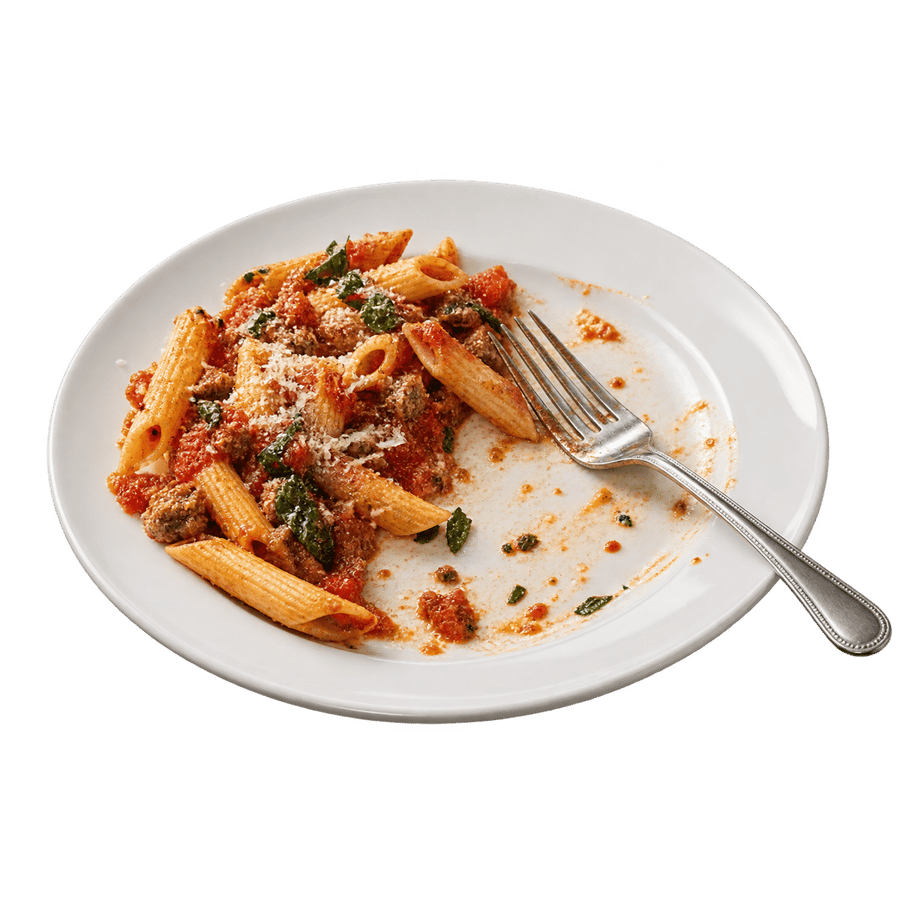
Energy is also the only one of the six that says nothing about what’s on the plate. A burger, fries and a soda is the right size for a 170 lb person eating three times a day, and it still misses all five of the other lines and grades a D. A plate needs the right size and the right food, which is why Energy is one meter in the six and never the whole grade.
What we’d do
Work out your day first, divide it by how many times you eat, and allow a quarter either side. Judge any plate against that window, never against a number from the internet. When you need to eat less, keep the palm of protein and the fist of plants the same size and shrink the starch and the fat. Don’t worry much about a plate that comes in a little light, since the next meal can make it up. The plates to watch are the ones well over the top of your window.
If you remember three things
- Your day over your meals. 2,000 calories over three meals is about 670 a plate, with a window of 500 to 830.
- Big costs more than light. A plate has to be under half your plate (330 calories here) to fail as too small, but the meter drops fast over the top and hits zero at about 1,330.
- The right size isn’t the same as good. A burger, fries and a soda fits the window and still grades a D on the other five.
Why isn’t there one right number?
Since May 2018, chain restaurants with 20 or more locations have had to post calories on their menus, with a statement that 2,000 calories a day is used for general nutrition advice, but calorie needs vary. That 2,000 is a reference number for labels. It isn’t anyone’s own number, and the rule says as much.
Researchers do the same thing when they need a benchmark. The Tufts team that measured restaurant meals in 2016 used 570 calories for a typical woman’s lunch or dinner. They got it from a 2,000 calorie day and the fact that Americans eat about 57% of their calories at lunch and dinner. It’s a fair benchmark for a study, and it’s too small for plenty of people.
The 2025 to 2030 US guidelines put it in one line: “The calories you need depend on your age, sex, height, weight, and level of physical activity.”
A simple way to picture it
Plate size works like splitting a paycheck into bills. An $800 bill is fine on one paycheck and a real problem on another, and nobody can tell you if it’s too much without knowing what you earn. Your day is the paycheck, your meals are the bills, and a plate is too big only if it’s too big for your day.
The picture holds in one more way. A bill that comes in a bit under is easy to live with, and one huge bill can wreck the whole month. The Energy meter treats plates the same way, gently when they’re light and hard when they’re big.
The arithmetic
Take your daily calories and divide by how many times you eat. That’s the middle of your window, and a quarter below and a quarter above is the range the meal checker counts as the right size. The last two columns are where the Energy meter fails a plate as too small, and where it runs out of points for one that’s too big.
| Your day | Meals | Middle | Window | Too small under | Zero at |
|---|---|---|---|---|---|
| 1,600 | 3 | 530 | 400 to 670 | 270 | 1,070 |
| 2,000 | 3 | 670 | 500 to 830 | 330 | 1,330 |
| 2,400 | 3 | 800 | 600 to 1,000 | 400 | 1,600 |
| 2,800 | 3 | 930 | 700 to 1,170 | 470 | 1,870 |
| 2,000 | 2 | 1,000 | 750 to 1,250 | 500 | 2,000 |
| 2,000 | 4 | 500 | 380 to 630 | 250 | 1,000 |
If you eat two meals and a real snack, count it as three. If you don’t know your day, tdee.guide works it out from your size and how much you move, and the plate size calculator does the rest, with protein and fiber for each plate. These are typical numbers, and the Gyroscope app personalizes yours.
How the Energy meter works
The meter runs from 0 to 100, like the other five. Any plate inside your window gets 100. A plate under the window loses a little, from 100 at the bottom of the window to about 83 at half a plate, and it still passes. On 2,000 calories over three meals, a 400 calorie plate gets 90 and clears the line.
Under half a plate it fails as small. That’s closer to a snack than a meal, and on the checker the protein and fiber usually fail with it.
Over the top of the window it falls fast. On 2,000 calories over three meals it loses about 2 points for every 10 calories over 830, so a 1,000 calorie plate gets 67 and a 1,330 calorie plate gets nothing. A plate has to pass Energy to be an A, the same as every other meter.
The meter leans this way because the two mistakes aren’t the same size. A light lunch is easy to make up at dinner. A 1,200 calorie plate is about what the average restaurant meal came to in the Tufts study, and on a 2,000 calorie day it leaves 800 for everything else.
 Chicken, rice and broccoli510 cal100
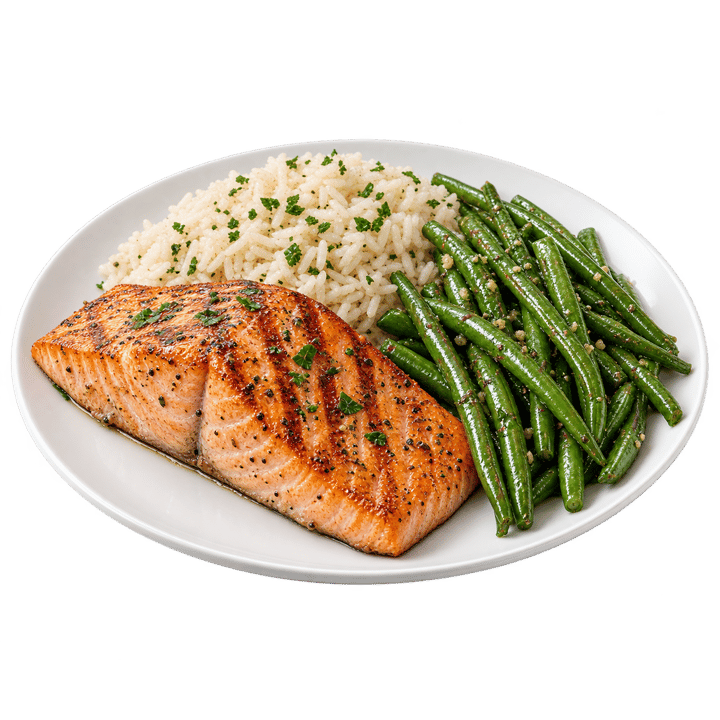
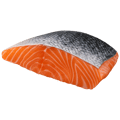 Salmon, a potato and green beans550 cal100
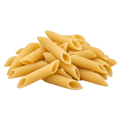 Spaghetti with meat sauce720 cal100
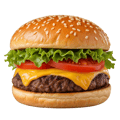 A burger, fries and a soda740 cal100
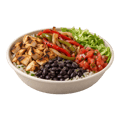 A loaded burrito bowl850 cal97
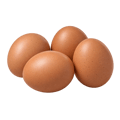 Eggs and toast400 cal90
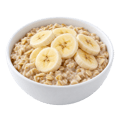 Oatmeal and a banana250 cal75
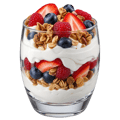 Greek yogurt and berries180 cal68
 A restaurant plate of spaghetti and bread1180 cal31
The burger combo gets the same full score as the salmon, since Energy only asks about size. The other five meters are where the burger loses.
How Gyroscope frames Energy
In the Gyroscope app, a meal’s Grade page shows the same six meters, and Energy shows how much of what fits your day the meal uses.
Gyroscope’s old A+ Meals guide said the energy meter is there more for your information than as a sign a meal is good or bad, since whether your meals should be big or small depends on what you’re working on. The checker here is the free version, worked out in the open from the USDA’s food table. The app works its meters out its own way, so a plate won’t always get the same number in both.
One plate, three people
Here’s a big plate: two palms of salmon, a sweet potato, a cup of asparagus, a cup of quinoa and a spoon of olive oil. It’s about 900 calories with over 60 g of protein, and it’s the same plate in all three cards below.


Salmon, sweet potato, asparagus and quinoa
2 palms salmon, 1 sweet potato, 1 cup asparagus, 1 cup quinoa, 1 tbsp olive oil
900 calories, 62 g protein, 12.5 g fiber
- Energyvery big900 cal
- Processingwhole100% whole food
- Musclehigh62 g protein
- Hungerfilling12.5 g fiber, 1.3 cal a gram
- Nutrientsdense2 cups of plants
- Glucosesteady0 g fast carbs
The one changeHave half the salmon and it's B+
Salmon, sweet potato, asparagus and quinoa
2 palms salmon, 1 sweet potato, 1 cup asparagus, 1 cup quinoa, 1 tbsp olive oil
900 calories, 62 g protein, 12.5 g fiber
- Energybig900 cal
- Processingwhole100% whole food
- Musclehigh62 g protein
- Hungerfilling12.5 g fiber, 1.3 cal a gram
- Nutrientsdense2 cups of plants
- Glucosesteady0 g fast carbs
The one changeHave half the quinoa and it's A+
Salmon, sweet potato, asparagus and quinoa
2 palms salmon, 1 sweet potato, 1 cup asparagus, 1 cup quinoa, 1 tbsp olive oil
900 calories, 62 g protein, 12.5 g fiber
- Energyfits900 cal
- Processingwhole100% whole food
- Musclehigh62 g protein
- Hungerfilling12.5 g fiber, 1.3 cal a gram
- Nutrientsdense2 cups of plants
- Glucosesteady0 g fast carbs
The one changeNone. It clears all six.
For the 140 lb person it’s a B, because 900 calories is a long way over a window that tops out at 670. For the 170 lb person it’s a B+, a little big, and half the quinoa makes it an A+. For the 200 lb person it’s an A+ as it is.
It works the other way too. The salmon, potato and green beans plate is about 550 calories and an A for a 170 lb person eating three times a day. Eating twice a day, the window moves up to 750 to 1,250 and the protein share to 45 g, so the same plate comes in light and short on protein.


Salmon, a potato and green beans
1 palm salmon, 1 baked potato, 1 cup green beans, 1 tbsp butter
550 calories, 30 g protein, 8.8 g fiber
- Energyfits550 cal
- Processingwhole100% whole food
- Musclehigh30 g protein
- Hungerfilling8.8 g fiber, 1.3 cal a gram
- Nutrientsdense2 cups of plants
- Glucosesteady46 g fast carbs
The one changeAdd a cup of broccoli and it's A
Salmon, a potato and green beans
1 palm salmon, 1 baked potato, 1 cup green beans, 1 tbsp butter
550 calories, 30 g protein, 8.8 g fiber
- Energylight550 cal
- Processingwhole100% whole food
- Musclevery low30 g protein
- Hungersome8.8 g fiber, 1.3 cal a gram
- Nutrientsdense2 cups of plants
- Glucosesteady46 g fast carbs
The one changeAdd a cup of broccoli and it's B
Is 800 calories a lot for a meal?
It depends on your day. On 1,600 calories over three meals, 800 is over your window of 400 to 670. On 2,400 over three it’s right in the middle, and on 2,000 over two it’s near the bottom of the window. The is this a lot calculator takes any number and shows its share of your day, with one plate built to clear all six meters and one from fast food at the same calories, so you can see that what’s on the plate counts as much as its size. There’s a short answer at is 800 calories a lot for a meal.
Restaurant meals are the usual reason a plate runs over. Tufts researchers measured 364 of the most ordered meals from 123 restaurants in Boston, San Francisco and Little Rock. They averaged about 1,200 calories, and 92% had more than 570. That average is over the window for anyone eating 2,800 a day or less over three meals. What to order when you eat out has the rules, starting with boxing half.
When you’re eating less, what shrinks?
When you’re trying to lose fat, the plate stays the same shape and gets smaller. Keep the palm of protein and the fist or two of plants, and shrink the starch and the fat. The protein you need doesn’t fall when your calories do, and protein and fiber are what keep a plate filling, so cutting them makes the plate harder to stick with. Rice, bread, oil and cheese are where the calories are easiest to cut without feeling it. Muscle and Hunger have the reasons, and what a meal should look like to lose weight has the plate.
For how big a cut to make, and how low is too low, see calories to lose weight on tdee.guide and bodyfat.guide.
Shouldn’t breakfast be small and dinner big, or the other way round?
You’ll hear both. In a 2022 trial, 30 adults with overweight or obesity spent four weeks on a calorie-cut diet with 45% of their calories at breakfast and 20% at dinner, and four weeks with the reverse, at the same total. They lost the same weight both ways and burned the same calories. They felt less hungry with the big breakfast.
The split is up to you, as long as the day adds up. That’s part of why the window is a quarter wide, and why a light plate still passes, so a small lunch and a bigger dinner both count as the right size. How many meals a day you should eat covers the rest.
6 sources
- US Food and Drug Administration, Menu labeling requirementsfda.gov
- Urban et al., Energy contents of frequently ordered restaurant meals and comparison with human energy requirements and US Department of Agriculture database information: a multisite randomized study, Journal of the Academy of Nutrition and Dietetics, 2016pmc.ncbi.nlm.nih.gov
- US Department of Agriculture and US Department of Health and Human Services, Dietary Guidelines for Americans, 2025 to 2030, January 2026cdn.realfood.gov
- Ruddick-Collins et al., Timing of daily calorie loading affects appetite and hunger responses without changes in energy metabolism in healthy subjects with obesity, Cell Metabolism, 2022europepmc.org
- Holt et al., A satiety index of common foods, European Journal of Clinical Nutrition, 1995europepmc.org
- Gebhardt and Thomas, Nutritive Value of Foods, USDA Agricultural Research Service, Home and Garden Bulletin 72, 2002 (the meal checker's food values)ars.usda.gov