What is a balanced meal? In grams, not adjectives
On this page
A balanced meal is one that does all six jobs a meal does. It fits your day, it’s mostly real food, it feeds your muscles, it holds you until the next meal, it brings minerals and vitamins, and it keeps your blood sugar steady. In your hand, that’s a palm of protein, a fist or two of vegetables, fruit or beans, a cupped hand of a starch you can name and a thumb of fat.
Everybody says “balanced” and nobody measures it. Ask ten people and you’ll hear everything in moderation, a bit of each food group, half the plate vegetables, or no carbs at night. The word sounds like advice, but you can’t hold a plate up against it and get an answer.
What we’d do
Use your hand to build the plate and the six jobs to check it. Start with the protein, because it’s the part most “healthy” plates are short on, then add the plants, then the starch, and let the fat be what you cook with. If the plate comes up short on one job, change one thing on it instead of starting again. The meal checker tells you which thing.
If you remember three things
- Palm, fist, cupped hand, thumb. A palm of protein, a fist or two of plants, a cupped hand of starch and a thumb of fat is a balanced plate for most adults.
- Protein is the job most plates miss. Oatmeal with a banana has 7 g. A plate needs about 30.
- Beans count twice. They’re a protein and a plant, and half a cup has about 7.5 g of fiber.
Why is “balanced” so hard to pin down?
Most of the pictures people grew up with describe area or variety. The CDC’s plate method for diabetes says to fill half a 9-inch plate with nonstarchy vegetables, a quarter with a lean protein and a quarter with carb foods. That’s a good picture, and it still works. But a quarter of a plate of chicken can be 2 oz or 8 oz, and a quarter of a plate of rice can be a half cup or a mound.
The 2025 to 2030 US guidelines moved the other way, to counts. At 2,000 calories a day they set 3 to 4 servings of protein foods, 3 of vegetables, 2 of fruit, 2 to 4 of whole grains and 3 of dairy, and they say to put protein at every meal. Counts are exact, but nobody wants to work out servings at dinner. Your hand sits between the two, since it’s always with you and it turns into grams.
The plate in your hand
| Part | Your hand | About | Good picks |
|---|---|---|---|
| Protein | A palm, no fingers | 3 oz of cooked meat, fish or poultry (CDC) | Chicken, fish, eggs, Greek yogurt, tofu, beans |
| Plants | A fist, once or twice | 1 cup, or one medium fruit (CDC) | Broccoli, green beans, berries, a side salad, beans |
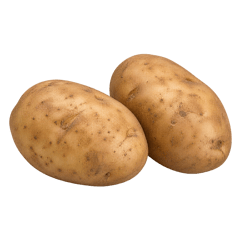
| Starch | A cupped hand | About ½ cup (MSU Extension) | A potato, brown rice, beans, whole wheat pasta, corn tortillas |
| Fat | A thumb tip | 1 tablespoon (CDC) | Olive oil, butter, avocado, a cupped hand of nuts |
Hands differ, so these are estimates, and a bigger person usually has a bigger palm. For grams, calories, protein and fiber from any hand measure, use the hand portions calculator.
A simple way to picture it
Think of a plate like packing for a trip. The protein is your shoes, since you can’t go without them and they take up real space. The plants are your clothes, and you need more of them than you think. The starch is the jacket, useful and sized to the weather, which here means how big your day is. The fat is the toothbrush, small and always there.
The six jobs, in numbers
Gyroscope grades every meal on six systems, and the meal checker is the free version. A balanced meal is one that clears all six lines. These are the lines for a 170 lb person eating 2,000 calories over three meals. Yours move with your weight and your day, and the Gyroscope app personalizes yours.
 EnergyIs it the right size for your day?
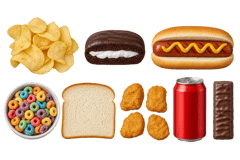 ProcessingIs it food, or a product made to be eaten fast?
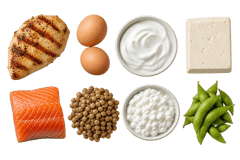 MuscleDoes it bring enough protein to keep and build muscle?
 HungerWill it hold you until the next meal?
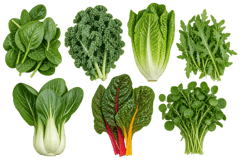 NutrientsDoes it bring minerals and vitamins for its calories?
 GlucoseDoes it keep your blood sugar steady?
- Energy: 500 to 830 calories. Your day over your meals, give or take a quarter. A lighter plate down to about 330 still passes, and a bigger one doesn’t.
- Processing: 70% or more whole food. No more than 30% of the calories from ultra-processed food, the kind made with industrial ingredients and additives.
- Muscle: 30 g of protein. That’s your share of 1.2 g per kg of body weight a day, the low end of the guidelines’ 1.2 to 1.6. A palm of chicken breast has about 27 g, a palm of salmon about 23 g.
- Hunger: protein, fiber and real food. The protein above, about 9 g of fiber (14 g per 1,000 calories of a plate your size), and food that weighs a lot for its calories.
- Nutrients: a fair share of the minerals and vitamins. A plate with a third of your calories should bring about a third of the Daily Value for calcium, potassium, iron and five vitamins, with about 1¾ cups of vegetables, fruit or beans.
- Glucose: few fast carbs. Added sugar of 10 g or less (the 2025 to 2030 guidelines’ line for one meal), no sweet drinks, and starch with fiber, protein and fat beside it.
Each meter scores from 0 to 100. The grade is the average of the six, and a plate has to clear all six lines to be an A. Miss one and it tops out at B+, however good the rest is. Why we grade meals this way.
One plate, worked
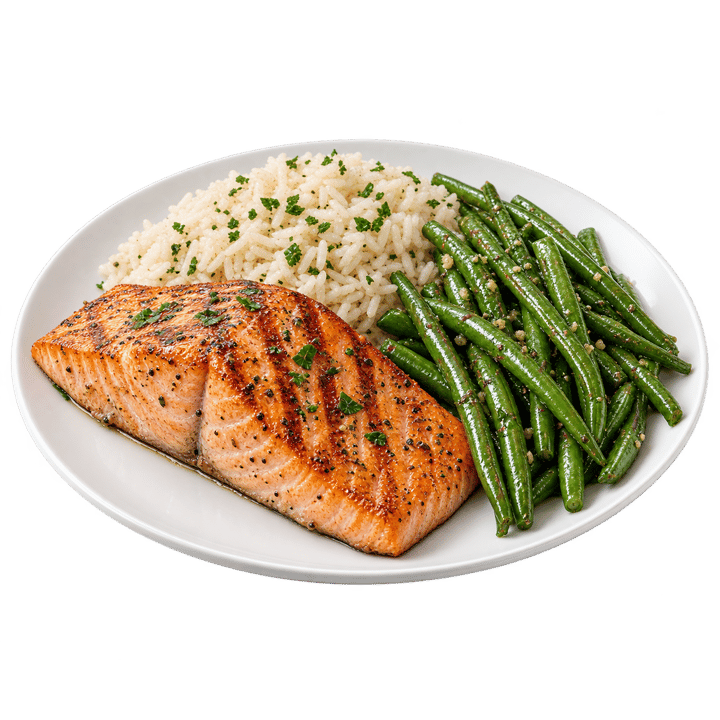
Take a palm of salmon (3 oz), a medium baked potato, a cup of green beans and a tablespoon of butter. It’s 550 calories with 30 g of protein, right on the line. The potato and green beans make 2 cups of plants and 8.8 g of fiber, nothing on it is ultra-processed and none of its sugar is added. It clears all six and it’s an A. The potato is the one soft spot, since a baked potato’s starch is the fast kind, so Glucose is its lowest meter.
Now a plate that sounds just as good, a cup of oatmeal and a banana. It’s all whole food, with 6.8 g of fiber and steady carbs, so Processing and Glucose clear easily. But it has 7 g of protein, and at 254 calories it’s well under half a plate, so Muscle, Hunger and Energy fall short, Nutrients just misses, and it’s a C. The checker’s one change is a cup of plain Greek yogurt on the side, which takes it to a B.


Salmon, potato and green beans
1 palm salmon, 1 baked potato, 1 cup green beans, 1 tbsp butter
550 calories, 30 g protein, 8.8 g fiber
- Energyfits550 cal
- Processingwhole100% whole food
- Musclehigh30 g protein
- Hungerfilling8.8 g fiber, 1.3 cal a gram
- Nutrientsdense2 cups of plants
- Glucosesteady46 g fast carbs
The one changeAdd a cup of broccoli and it's A


Chicken, white rice and broccoli
1 palm chicken breast, 1 cup white rice, 1 cup broccoli, 1 tbsp olive oil
510 calories, 36 g protein, 5.1 g fiber
- Energyfits510 cal
- Processingwhole100% whole food
- Musclehigh36 g protein
- Hungerfilling5.1 g fiber, 1.2 cal a gram
- Nutrientsdense1 cup of plants
- Glucosesteady44 g fast carbs
The one changeSwap the white rice for black beans and it's A+


Oatmeal and a banana
1 cup oatmeal, 1 banana
250 calories, 7 g protein, 6.8 g fiber
- Energysmall250 cal
- Processingwhole100% whole food
- Musclevery low7 g protein
- Hungersome6.8 g fiber, 0.7 cal a gram
- Nutrientssome1 cup of plants
- Glucosesteady0 g fast carbs
The one changeAdd a cup of plain Greek yogurt and it's B
The middle plate is the one most people would call balanced. It clears all six lines too, but it’s a B+, because Nutrients and Glucose only just clear theirs. A cup of white rice brings almost no fiber or minerals, and its carbs are the fast kind. Swap the rice for a cup of black beans and every meter goes up at once. More plates like these are in A+ meals, graded.
Why six jobs, and why these
Each meter stands for something your body does with a meal. Protein keeps and builds muscle and, with fiber, decides a lot of how full you stay. Ultra-processed food is easy to overeat, and in a 2019 NIH study people ate about 500 more calories a day on it without noticing. Minerals and vitamins come mostly from plants, beans, dairy, meat and fish, and a plate that brings few of them for its calories leaves the rest of the day to catch up. Fast carbs push blood sugar up quickly. And size keeps the plate in step with your day.
None of these is the same as “healthy”. A bowl of fruit is all whole food and rich in vitamins, and it still misses Muscle and Hunger. Spaghetti with meat sauce has plenty of protein and still misses Nutrients and Glucose. Balance means the plate covers all six at once, which is why the old Gyroscope A+ Meals guide called it a checklist.
Salt and saturated fat aren’t meters here, so the checker can’t tell you about those. NOVA, the system behind the Processing meter, sorts foods by how they were made. Ultra-processed foods are the ones made with industrial ingredients like hydrogenated oils and hydrolysed proteins, or additives like flavor enhancers and emulsifiers.
Is grading one plate even meaningful?
Nutrition studies mostly follow whole diets over years, and no trial has tested this checker. A single plate on its own doesn’t make you healthier or less healthy.
The plate is where you make the choice, though. Nobody decides on a diet at 7 pm, they decide on dinner. Each line in the checker comes from the US guidelines, the FDA’s Daily Values or a trial, and a day made of plates that clear them adds up to a day that meets the guidelines. We think a plate grade is the most useful unit for a person to work with, as long as nobody treats one C as a failure.
Your turn
Put tonight’s dinner in the meal checker and see which meter comes up short. If you don’t know how big your plate should be, start with plate size. The one minute plate grade quiz grades the dinner and breakfast you eat most and gives you the change for each.
9 sources
- US Department of Agriculture and US Department of Health and Human Services, Dietary Guidelines for Americans, 2025 to 2030, January 2026cdn.realfood.gov
- US Department of Agriculture and US Department of Health and Human Services, Daily Servings by Calorie Level, Dietary Guidelines for Americans 2025 to 2030cdn.realfood.gov
- CDC, Diabetes meal planning (the plate method and hand portions), May 2024cdc.gov
- Mississippi State University Extension, HappyHealthy: how to measure food using your handshappyhealthy.extension.msstate.edu
- NIDDK, Eating, diet and nutrition for diverticular disease (the 2020 to 2025 guidelines recommend 14 g of fiber per 1,000 calories)niddk.nih.gov
- Hall et al., Ultra-processed diets cause excess calorie intake and weight gain: an inpatient randomized controlled trial of ad libitum food intake, Cell Metabolism, 2019pmc.ncbi.nlm.nih.gov
- Monteiro et al., Ultra-processed foods: what they are and how to identify them, Public Health Nutrition, 2019europepmc.org
- Gebhardt and Thomas, Nutritive Value of Foods, USDA Agricultural Research Service, Home and Garden Bulletin 72, 2002 (the meal checker's food values)ars.usda.gov
- US Food and Drug Administration, Daily Value on the Nutrition and Supplement Facts Labels, March 2024fda.gov