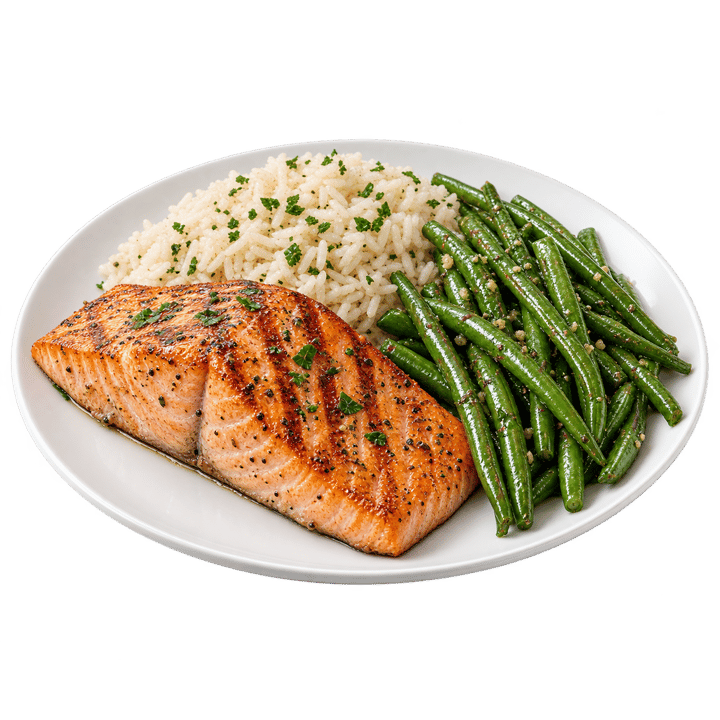
How many meals a day should you eat?
On this page
Two to five meals a day all work, as long as the day’s calories and protein add up. Fewer meals means bigger plates with more protein at each one, and more meals means smaller plates. Pick the number that keeps you from getting ravenous, and make each plate carry its share of protein.
Two old ideas pull in opposite directions. One says eat six small meals to “keep your metabolism going.” The other says eat once or twice and fast the rest of the day. Both get sold as the key to losing weight, and the evidence for either one as a rule is thin.
The six-meal idea was tested. In 2015, Brad Schoenfeld, Alan Aragon and James Krieger pooled 15 studies on how often people ate. At first, eating more often looked slightly better for fat loss. Then they checked what happened when each study was left out, and the whole effect turned out to come from a single study. Without it, how often people ate made no difference. tdee.guide covers why the burn from digesting food doesn’t change with how you split it.
We’d pick the number of meals that fits your day and your hunger. Three is the easy default, because it puts each plate at a protein amount most people can hit without trying hard.
Splitting your day into meals is like paying rent monthly or every two weeks. The total is the same either way.

What each plate needs at each number of meals
Here’s how it works out for a 170 pound person eating 2,000 calories a day.
| Meals | Each plate’s calories | Each plate’s protein |
|---|---|---|
| 2 | 750 to 1,250 | 50 to 65 g |
| 3 | 500 to 830 | 30 to 40 g |
| 4 | 380 to 630 | 25 to 30 g |
| 5 | 300 to 500 | 20 to 25 g |
The protein is the typical range from the 2025 to 2030 US guidelines, 1.2 to 1.6 g per kg of body weight a day, split evenly. The Gyroscope app personalizes yours. The plate size calculator works it out for any weight, day and number of meals.
Where meal count does make a difference
It changes how your protein is spread across the day. In a 2014 study, eight adults ate the same 90 g of protein a day split evenly (about 30 g at each of three meals) or skewed (10 g, 15 g and 65 g). Muscle building over 24 hours was about 25% higher on the even split. For people lifting to build muscle, a 2018 review suggested about 0.4 g of protein per kg at each of at least four meals.
Two meals a day can work fine for weight, but it makes the protein harder. Fitting 50 to 65 g into one plate takes about two palms of meat or fish, which is a big plate for a lot of people.
What to do
- Start with three meals and adjust if you’re hungry between them.
- Make every plate carry its protein, breakfast included.
- Count snacks as small meals and take them out of the day before sizing your plates.
- If you eat twice a day, build each plate around two palms of protein.
4 sources
- Schoenfeld, Aragon and Krieger, Effects of meal frequency on weight loss and body composition: a meta-analysis, Nutrition Reviews, 2015europepmc.org
- Mamerow et al., Dietary protein distribution positively influences 24-h muscle protein synthesis in healthy adults, Journal of Nutrition, 2014pmc.ncbi.nlm.nih.gov
- Schoenfeld and Aragon, How much protein can the body use in a single meal for muscle-building? Implications for daily protein distribution, Journal of the International Society of Sports Nutrition, 2018pmc.ncbi.nlm.nih.gov
- US Department of Agriculture and US Department of Health and Human Services, Dietary Guidelines for Americans, 2025 to 2030, January 2026cdn.realfood.gov