Is my meal healthy?
Look at the whole plate, not one food on it, and ask how it does at the six jobs a meal does. Is it the right size for your day, mostly food you could name, enough protein for your muscles, filling enough to hold you, rich in minerals and vitamins for its calories, and steady on your blood sugar? Put yours in the meal checker to get its grade and the one change that lifts it.
Most people judge a meal by its star. Oatmeal sounds healthy and a burger sounds bad, so the oatmeal wins. But a bowl of oatmeal with a banana has about 7 g of protein, a quarter of what a 170 pound person needs at a meal, and it grades C. A grilled chicken breast with a buttered baked potato and a side salad grades A, and nothing on that plate sounds like health food. Some foods really are poor value, like a doughnut, but most good foods only do one or two of the jobs a meal has, so the whole plate decides it. Every meal is a supply run has the six jobs we check.
We’d judge every plate the same way, on the six systems Gyroscope grades a meal on. Then we’d fix the one thing it’s missing and leave the rest alone, because one small change is something you’ll still be doing next month.
A plate works like a soccer team. One star player doesn’t help much if nobody’s in goal.
What are the six jobs?
These are the lines for a 170 pound person eating 2,000 calories a day over three meals. The plate size calculator works out yours, and the Gyroscope app personalizes yours.
| System | The job | The line |
|---|---|---|
| Energy | Is it the right size for your day? | About 330 to 830 calories: your day over your meals, up to a quarter over |
| Processing | Is it mostly food you could name? | 30% of the calories or less from ultra-processed food. In a 2019 NIH study, people ate about 500 more calories a day on ultra-processed meals |
| Muscle | Does it feed your muscles? | 30 g of protein. The 2025 to 2030 US guidelines say to put protein at every meal, 1.2 to 1.6 g per kg of body weight a day |
| Hunger | Will it hold you until the next meal? | Protein, about 9 g of fiber (14 g per 1,000 calories) and food that weighs a lot for its calories |
| Nutrients | Does it bring minerals and vitamins? | A fair share of the Daily Values for its calories, with about 1¾ cups of vegetables, fruit or beans |
| Glucose | Will it keep your blood sugar steady? | Few fast carbs. The guidelines say “one meal should contain no more than 10 grams of added sugars” |
The grade is the average of the six, and a plate has to clear every line to be an A.
How do real plates do?
| Plate | Grade | What it misses | The one change |
|---|---|---|---|
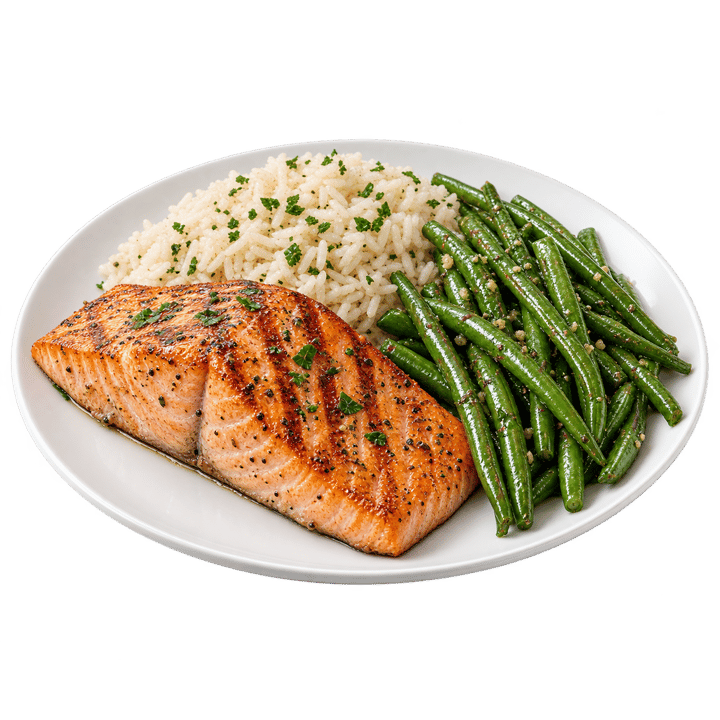
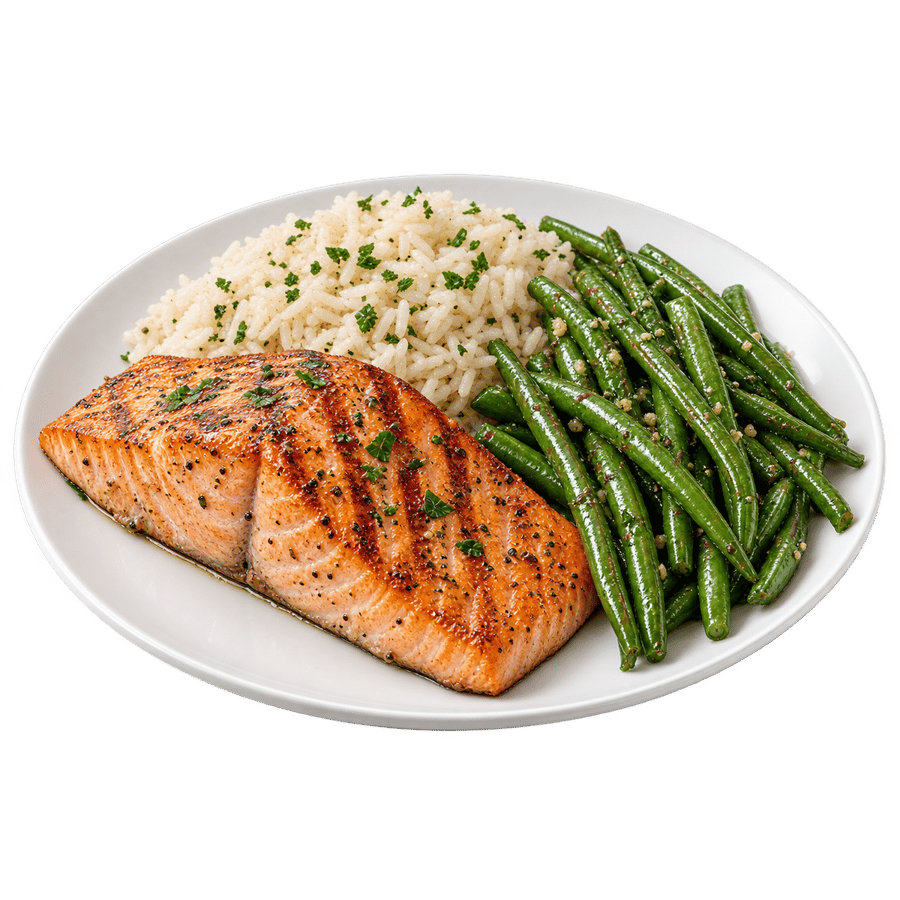
| Salmon, a baked potato, green beans and butter | A | Nothing | Add a cup of broccoli: still an A |
| Chicken, white rice and broccoli | B+ | Nothing, but Nutrients and Glucose only just clear | Swap the rice for black beans: A+ |
| Spaghetti with meat sauce | B | Nutrients and Glucose | Whole wheat pasta: B+ |
| Two eggs and buttered toast | C | Processing, Muscle, Hunger and Nutrients | Add a cup of Greek yogurt: B |
| Cereal and milk | D | Everything but Nutrients | Oatmeal with berries instead: C+ |
| A cheeseburger, fries and a soda | D | Everything but Energy | A cup of broccoli for the fries: C |
The surprising part is how far one swap goes. Chicken, rice and broccoli jumps from B+ to A+ by changing a single scoop, because a cup of black beans brings 15 g of fiber and a cup of white rice brings less than 1.
Why is processing one of the six?
In 2019, NIH researchers had 20 adults live at the NIH Clinical Center for four weeks. For two weeks they ate ultra-processed meals and for two weeks unprocessed ones, as much as they wanted. The meals offered the same calories, sugar, fat, fiber and salt. On the ultra-processed food people ate about 500 more calories a day, ate faster, and gained about 2 pounds. On the unprocessed food they lost about 2.
That’s the food most Americans eat. In the CDC’s latest survey, 53% of adults’ calories came from ultra-processed food, and sandwiches and burgers were the biggest single source.
What to do
- Build around a palm of protein and a fist or two of plants. The rest of the plate fills in around them.
- Drink water with the meal. A 12 oz soda is about 37 g of sugar on its own, enough to sink the Glucose meter on a plate that clears everything else.
- Change one thing at a time. The meal checker tries every small swap on your plate and shows the one that lifts the grade most.
5 sources
- US Department of Agriculture and US Department of Health and Human Services, Dietary Guidelines for Americans, 2025 to 2030, January 2026cdn.realfood.gov
- US Department of Agriculture and US Department of Health and Human Services, Daily Servings by Calorie Level, 2025 to 2030cdn.realfood.gov
- Hall et al., Ultra-processed diets cause excess calorie intake and weight gain: an inpatient randomized controlled trial of ad libitum food intake, Cell Metabolism, 2019pmc.ncbi.nlm.nih.gov
- Williams et al., Ultra-processed food consumption among youth and adults: United States, August 2021 to August 2023, NCHS Data Brief 536, 2025cdc.gov
- Gebhardt and Thomas, Nutritive Value of Foods, Home and Garden Bulletin 72, USDA Agricultural Research Service, 2002ars.usda.gov