A salad is always the healthy order
Short answerNo
On this page
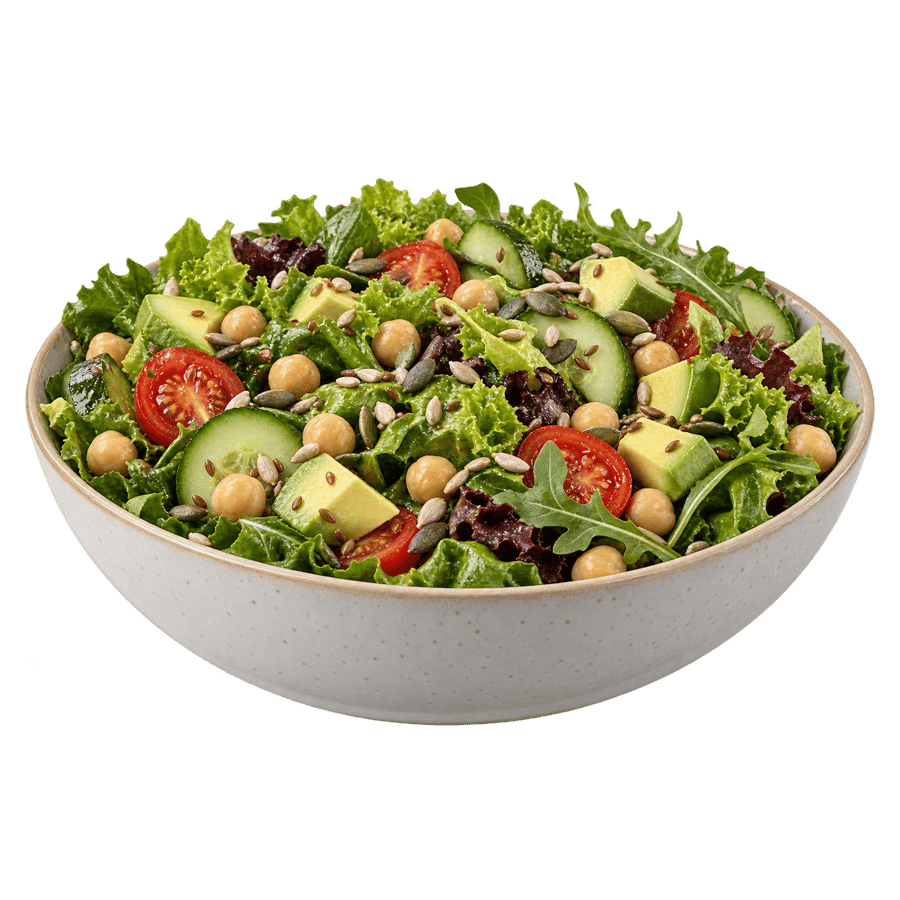
No. Three salads on the meal checker land from an A down to a C. The lettuce changes the grade least. The protein on top and the dressing decide whether a salad is a meal, a decent lunch or a bowl of leaves with sauce.
What we’d do
Order the salad when it has a real protein on it, like grilled chicken, fish, eggs or beans, and ask for the dressing on the side. Add beans or corn if they’re offered, since that’s where the fiber is. A side salad with dressing is a good starter, and you’ll still want a main.
If you remember three things
- The lettuce barely counts. Three cups have about 24 calories and 3 g of fiber.
- The dressing can be ten times the lettuce. A quarter cup of ranch has about 256 calories.
- Protein makes it a meal. A side salad has about 3 g. A plate needs about 30.
Why people believe it
Salad means vegetables, and vegetables mean healthy, so ordering one feels like the right call before you’ve looked at what’s in it. Menus use the word for very different dishes. A bowl of fried chicken, cheese and ranch on a bed of romaine gets called a salad, and so does a plate of grilled fish and beans.
Gyroscope’s old A+ Meals guide said the salad “could range from an F to an A depending on what is in it”, and that still holds. A salad isn’t healthy or unhealthy by its name. A meal does six jobs, and the leaves only help with two of them (the minerals and vitamins, and some of the fiber that keeps you full). They’re the part everyone sees, and they’re the part that changes the grade least. The six jobs of a meal explains the idea.
A simple way to picture it
The lettuce in a salad is like the paint on a car. It’s what you notice from the outside, and it tells you almost nothing about what’s under the hood. The protein is the engine.
Three salads, graded
These are graded on the meal checker for a 170 lb person eating 2,000 calories over three meals, on the six systems Gyroscope uses.


Grilled chicken, beans and corn
3 cups salad greens, 1 palm chicken breast, 1 tomato, ½ cup corn, ½ cup black beans, 2 tbsp italian dressing
510 calories, 41 g protein, 13.9 g fiber
- Energyfits510 cal
- Processingwhole73% whole food
- Musclehigh41 g protein
- Hungerfilling13.9 g fiber, 0.9 cal a gram
- Nutrientsdense3½ cups of plants
- Glucosesteady2 g fast carbs
The one changeSwap the bottled dressing for a spoon of olive oil and vinegar and it's A+
The beans and corn bring most of the fiber. Even here the bottled dressing is what holds it back.

Crispy chicken with cheese and ranch
3 cups salad greens, 1 palm fried chicken, 1 oz cheddar cheese, 4 tbsp ranch dressing
620 calories, 32 g protein, 3.3 g fiber
- Energyfits620 cal
- Processingmixed58% whole food
- Musclehigh32 g protein
- Hungersome3.3 g fiber, 1.8 cal a gram
- Nutrientsdense1½ cups of plants
- Glucosesteady4 g fast carbs
The one changeSwap the ranch for salsa and it's A
Plenty of protein, but the ranch makes more than 40% of it ultra-processed, and it has little fiber.

A garden salad with bottled dressing
3 cups salad greens, 1 tomato, ½ cup cucumber, 4 tbsp italian dressing
330 calories, 5 g protein, 4.8 g fiber
- Energysmall330 cal
- Processingprocessed17% whole food
- Musclevery low5 g protein
- Hungerlight4.8 g fiber, 0.8 cal a gram
- Nutrientsdense3 cups of plants
- Glucosesteady4 g fast carbs
The one changeAdd a palm of chicken breast and it's B
Almost no protein, and most of its calories come from the dressing. It works as a starter beside a main.
The quiz’s big chicken salad with 2 tablespoons of ranch lands with the crispy one. The protein is there. It loses on Processing, because of the bottled dressing, and on Energy, since at about 330 calories it’s under half a plate. The garden salad is also our favorite example of a light lunch that fails Hunger, and there are more upsets like it in meals that grade the opposite of what you’d guess.
What decides the grade
The protein. A palm of grilled chicken brings about 27 g, which nearly covers a plate’s protein line by itself and lifts the Muscle and Hunger meters together. Without it, a salad is mostly water and dressing. The 2025 to 2030 US guidelines say to put protein at every meal, and a bowl of leaves has almost none.
The dressing. Bottled ranch has about 64 calories a tablespoon, and a quarter cup is four of them. Bottled dressings also count as ultra-processed on the checker, so a lot of dressing on a small salad fails the Processing meter. A tablespoon of olive oil with vinegar isn’t ultra-processed, at about 120 calories. On the chicken, beans and corn salad, that one swap is the checker’s one change, and it takes the salad from an A to an A+.
The toppings. Beans, corn, chickpeas and other vegetables lift the fiber, the minerals and the plants. Croutons, crispy tortilla strips, candied nuts, bacon and fried chicken add calories and processing with little fiber.
The best case for salad
Even the garden salad is good at two jobs, Nutrients and Glucose, and a side salad before a meal is a good habit. In a 2015 trial, eating the vegetables and protein before the bread lowered blood sugar after the same meal, so starting with the salad has a real benefit of its own. Vegetables first, bread last has the numbers. The trouble only starts when a side salad is the whole meal, or when the salad is mostly fried chicken and sauce.
More detail: how the three salads add up
The chicken, beans and corn salad gets 3½ cups of plants from the lettuce (which counts at half, since two cups of leafy greens make one serving), the tomato, the corn and the beans, and 13.9 g of fiber, well over the 9.3 g a plate this size needs for the Hunger meter. Its 2 tablespoons of bottled Italian are about a quarter of its calories, so Processing still clears its line. The crispy chicken salad has only the lettuce for plants and 3.3 g of fiber, and more than 40% of its calories come from the ranch, which is ultra-processed, so Processing and Hunger miss. The garden salad’s 4 tablespoons of bottled Italian add about 276 calories and 6.5 g of sugar to about 60 calories of vegetables, so most of its calories are ultra-processed and it has about 5 g of protein.
5 sources
- Gebhardt and Thomas, Nutritive Value of Foods, USDA Agricultural Research Service, Home and Garden Bulletin 72, 2002 (the meal checker's food values)ars.usda.gov
- Ranch dressing, 426.67 calories per 100 g and 15 g per tablespoon, USDA Standard Reference, on nutritionvalue.orgnutritionvalue.org
- US Department of Agriculture and US Department of Health and Human Services, Dietary Guidelines for Americans, 2025 to 2030, January 2026cdn.realfood.gov
- Shukla et al., Food order has a significant impact on postprandial glucose and insulin levels, Diabetes Care, 2015pmc.ncbi.nlm.nih.gov
- Monteiro et al., Ultra-processed foods: what they are and how to identify them, Public Health Nutrition, 2019europepmc.org