Is white rice bad for you?
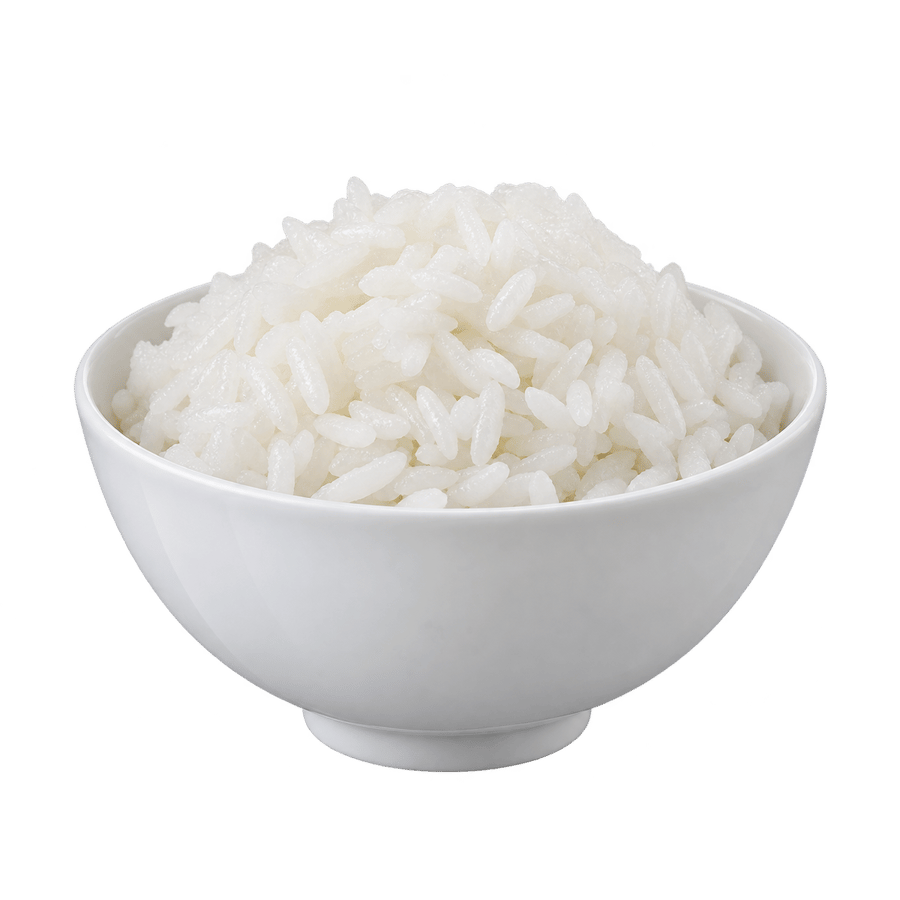
Not on its own. A cup of cooked white rice has about 205 calories and 0.6 g of fiber, so it adds energy and almost nothing toward the fiber line. Put it next to beans and a vegetable, or swap half of it for beans, and the plate grades A or better.
White rice gets defended as a staple and attacked as a refined carb with nothing in it. Both sides have a point, and the useful question is what’s next to it on the plate.
The difference is the bran. Brown rice keeps the outer bran layer, and a cup has 3.5 g of fiber. White rice has the bran milled off and has 0.6 g. The calories and protein are about the same.
We’d keep white rice if you love it and fix the plate around it. Half rice and half black beans is our favorite move, because it keeps the rice you like and adds about 7 g of fiber and 5 g of protein.
White rice is like a plain white T-shirt. There’s nothing wrong with it, it just needs the rest of the outfit.
How does the rice change the grade?
The same dinner with a palm of chicken, a cup of broccoli and a tablespoon of olive oil, for a 170 pound person on 2,000 calories over three meals:
| The starch | Fiber on the plate | Grade |
|---|---|---|
| 1 cup white rice | 5 g | B+ |
| 1 cup brown rice | 8 g | A |
| ½ cup white rice and ½ cup black beans | 12 g | A+ |
| 1 cup black beans | 20 g | A+ |
The white rice plate clears all six of the jobs a meal does, but only just on two of them. A cup of white rice brings little fiber or minerals, so Nutrients sits near its line, and its carbs count as fast ones on the Glucose meter. Beans fix both, since they bring fiber, minerals and protein and their carbs are slow. That’s why our meal checker almost always suggests a bean swap for rice plates instead of telling you to cut the rice.
Brown rice helps less than you’d guess. It has about 13 g of carbs for every gram of fiber, so it still counts as fast on Glucose, and most of what it adds is fiber for the Hunger meter.
What do the big studies say?
In 2010, researchers followed about 197,000 US men and women for years. People who ate white rice five or more times a week had about a 17% higher risk of type 2 diabetes than people who ate it less than once a month. People who ate brown rice twice a week or more had about an 11% lower risk. The researchers estimated that swapping 50 g of cooked white rice a day (about a third of a cup) for brown rice went with a 16% lower risk.
A 2012 review pooled seven studies with 352,384 people. Each extra daily serving of white rice went with an 11% higher risk of type 2 diabetes. The link was strong in Chinese and Japanese people, and small and not statistically clear in Western countries.
These are studies that watch what people eat, not trials, so they show a link rather than proof. People who eat lots of white rice may differ in other ways too. But the direction matches the fiber story.
What to do
- Keep the rice and add beans, half and half.
- Try brown rice if you like it. It has about six times the fiber.
- Put a vegetable next to it, a fist or two.
- Measure it once. A cup of cooked rice is about a fist.
3 sources
- Gebhardt and Thomas, Nutritive Value of Foods, Home and Garden Bulletin 72, USDA Agricultural Research Service, 2002ars.usda.gov
- Hu et al., White rice consumption and risk of type 2 diabetes: meta-analysis and systematic review, BMJ, 2012europepmc.org
- Sun et al., White rice, brown rice, and risk of type 2 diabetes in US men and women, Archives of Internal Medicine, 2010europepmc.org