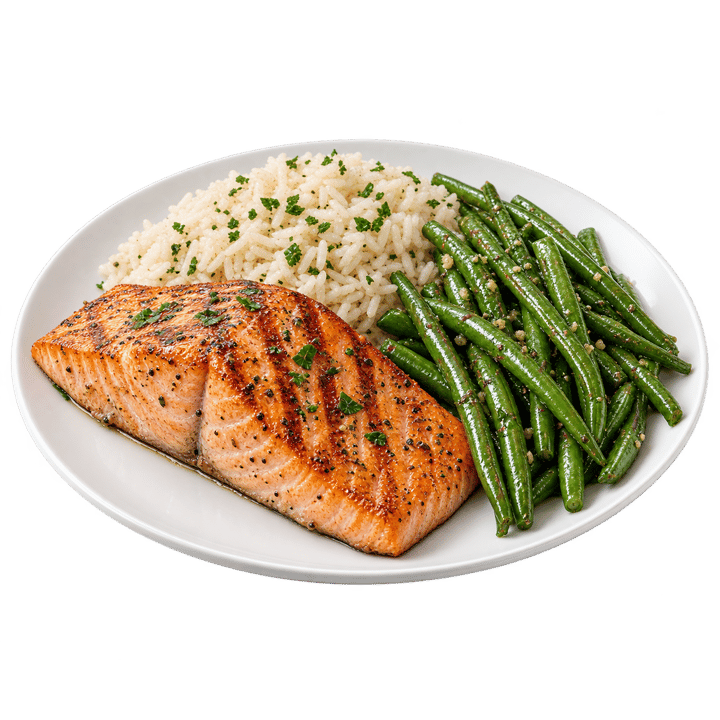
How much fiber should a meal have?
About 14 g for every 1,000 calories on the plate, so 8 to 9 g on a 600 calorie plate. Half a cup of black beans or lentils is most of that on its own. The average American gets about 8 g per 1,000 calories, a bit over half.
Ask people where fiber comes from and you’ll hear bran cereal, supplements and salad. The salad is the surprise. Two cups of lettuce have about 2 g of fiber, so a big side salad gets you less than a quarter of a meal’s worth. Lettuce is a lot like packing peanuts. It takes up plenty of room and there isn’t much in it.
The real fiber foods are beans, lentils, peas, whole grains, potatoes with the skin, berries and most cooked vegetables. And most Americans aren’t eating enough of them. The 2020 to 2025 US guidelines found that more than 90% of women and 97% of men fall short.
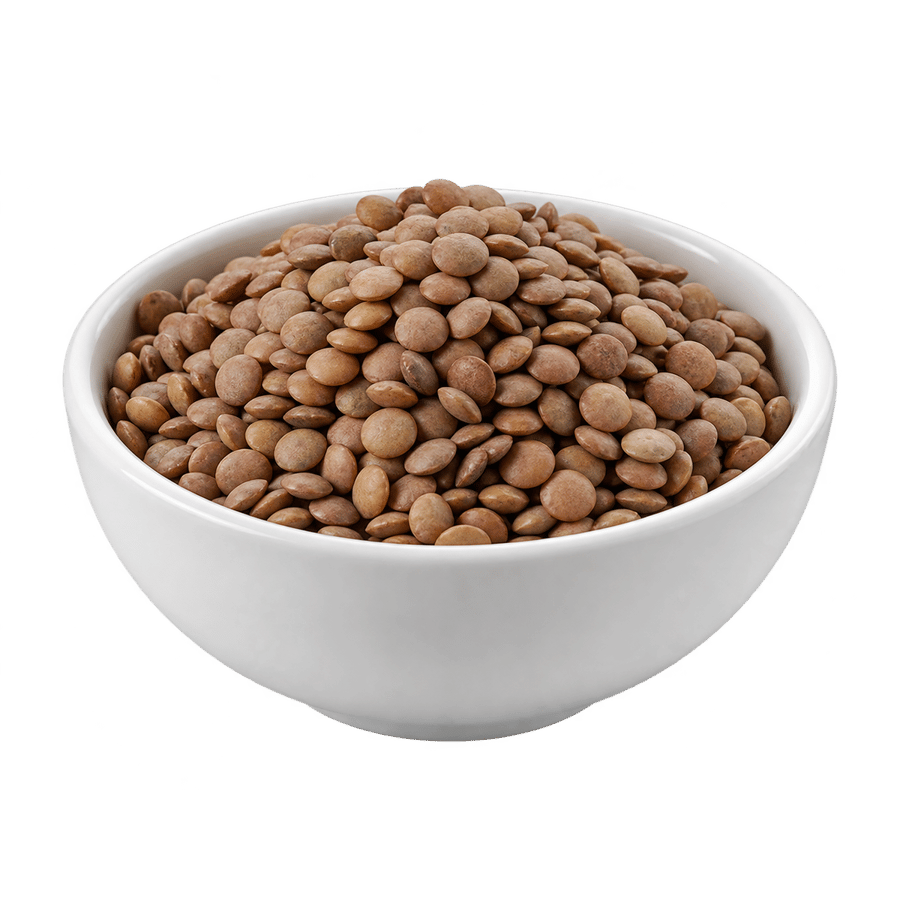
We’d put beans or lentils on more plates. They’re cheap, the canned ones need no cooking, and half a cup does more for the fiber line than anything else on this page.
Where’s the fiber?
The numbers come from the USDA’s Nutritive Value of Foods.
| Food | Amount | Fiber |
|---|---|---|
| Green peas | 1 cup | 8.8 g |
| Lentils | ½ cup | 7.8 g |
| Black beans | ½ cup | 7.5 g |
| Chickpeas | ½ cup | 6.2 g |
| A baked potato with skin | 1 medium | 4.8 g |
| Broccoli | 1 cup | 4.5 g |
| Blueberries | 1 cup | 3.9 g |
| An apple | 1 medium | 3.7 g |
| Brown rice | 1 cup | 3.5 g |
| Almonds | 1 oz | 3.3 g |
| Lettuce | 2 cups | 2.0 g |
| Whole wheat bread | 1 slice | 1.9 g |
| White rice | 1 cup | 0.6 g |
| White bread | 1 slice | 0.6 g |
White rice explains a lot of B+ grades. Chicken, white rice and broccoli has about 5 g of fiber, short of the 9 g our checker looks for on a plate this size, and only the chicken’s protein carries it over the Hunger line. Swap the rice for black beans and it has about 19, and the plate goes from a B+ to an A+.
Why 14 g per 1,000 calories?
It’s what the 2020 to 2025 US guidelines recommend, which works out to 28 g a day at 2,000 calories, 22 g at 1,600 and 34 g at 2,400. It scales with the plate, so a 500 calorie lunch needs 7 g and an 800 calorie dinner needs about 11.
A big set of reviews in The Lancet in 2019 backs it up. The researchers pulled together 185 long-term studies and 58 trials. People who ate the most fiber had a 15 to 30% lower risk of dying early, heart disease, stroke, type 2 diabetes and colon cancer than people who ate the least, and the benefit was largest at 25 to 29 g a day. In the trials, more fiber lowered body weight, blood pressure and cholesterol. The long-term studies show a link rather than proof, and the trials back up the direction.
What to do
- Add half a cup of beans or lentils to one meal a day.
- Swap one white starch for brown rice, whole wheat pasta or a potato with the skin.
- Add a fist of a cooked vegetable, not only lettuce.
- Go up slowly and drink water with it.
The meal checker counts fiber in its Hunger meter, against 14 g per 1,000 calories of a plate that fits your day, about 9 g on 2,000 calories over three meals.
5 sources
- National Institute of Diabetes and Digestive and Kidney Diseases, Eating, Diet, and Nutrition for Diverticular Disease (fiber at 14 g per 1,000 calories)niddk.nih.gov
- USDA Economic Research Service, Chart of Note on US fiber intake per 1,000 calories, 2017 to 2018 dataers.usda.gov
- Thompson, The Dietary Guidelines for Americans (2020 to 2025): pulses, dietary fiber, and chronic disease risk, Nutrients, 2021pmc.ncbi.nlm.nih.gov
- Reynolds et al., Carbohydrate quality and human health: a series of systematic reviews and meta-analyses, The Lancet, 2019europepmc.org
- Gebhardt and Thomas, Nutritive Value of Foods, Home and Garden Bulletin 72, USDA Agricultural Research Service, 2002ars.usda.gov