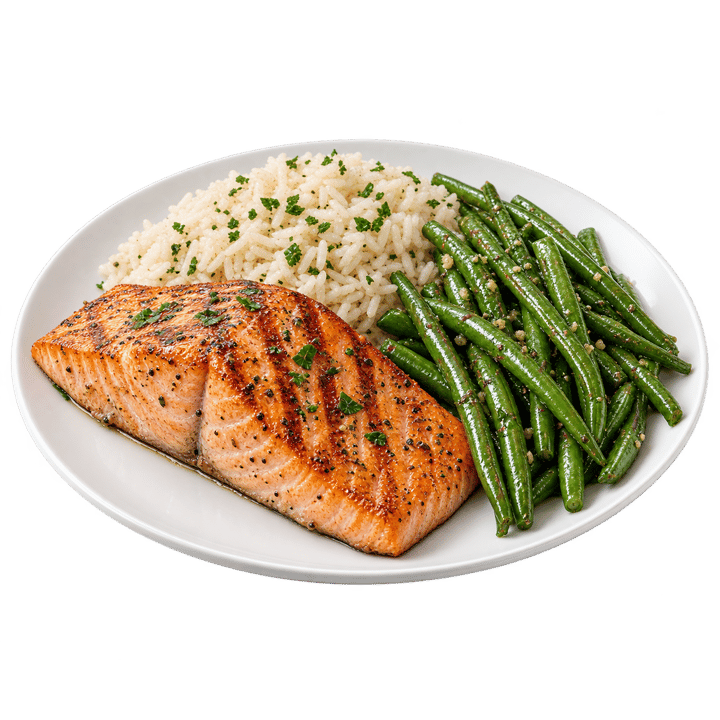
How many calories are in a restaurant meal?
About 1,200 calories on average. Tufts researchers measured 364 of the most often ordered meals at 123 restaurants in three US cities, and found they averaged 1,205 calories. 92% had more than 570, which is what a typical woman needs at one lunch or dinner.
Most people guess low. A plate of pasta or a stir fry doesn’t look like 1,200 calories. The Tufts team wanted the real figure, so they went and got the food.
The researchers bought the most popular dishes at non-chain restaurants in Boston, San Francisco and Little Rock, took them to a lab, and measured the energy in each one by bomb calorimetry. That means burning a sample in a sealed chamber and measuring the heat, and it’s accurate to about 2%.
We’d treat a restaurant plate as two meals until you know otherwise. Eat half, box half, and you’re inside the window for most people.
A restaurant plate is like a two-pack sold as a single.
Which cuisines were biggest?
Italian, Chinese and American food came out highest, with meals averaging about 1,500 calories. Italian was the top, at about 1,550. Chain restaurants weren’t any better. On a subset of meals, chain and non-chain dinners came out about the same, about 1,320 and 1,390 calories.
How does 1,200 compare with my plate?
| Your day | Plate window (3 meals) | A 1,200 calorie meal is |
|---|---|---|
| 1,600 | 400 to 670 | 75% of your day |
| 2,000 | 500 to 830 | 60% of your day |
| 2,400 | 600 to 1,000 | 50% of your day |
| 2,800 | 700 to 1,170 | 43% of your day, just over the window |
For most people, half the plate lands inside the window and the whole plate lands well over it, which is a miss on the Energy meter, the first of the six jobs a meal does. The is this a lot calculator works this out for any menu number.
What to do
- Ask for a box when the food comes, and put half in it before you start.
- Order a vegetable side and a protein you can see, and drink water.
- Get the sauce on the side. A tablespoon of oil or creamy dressing is 60 to 120 calories, and you can’t see it once it’s mixed in.
- Share a starter or dessert instead of each getting one.
- Use the plate size calculator to know your own window before you go.
The 2025 to 2030 US guidelines say “when dining out, choose nutrient-dense options.” Half a big plate of good food is a fine way to do that.
3 sources
- Urban et al., Energy contents of frequently ordered restaurant meals and comparison with human energy requirements and US Department of Agriculture database information: a multisite randomized study, Journal of the Academy of Nutrition and Dietetics, 2016pmc.ncbi.nlm.nih.gov
- US Department of Agriculture and US Department of Health and Human Services, Dietary Guidelines for Americans, 2025 to 2030, January 2026cdn.realfood.gov
- Gebhardt and Thomas, Nutritive Value of Foods, Home and Garden Bulletin 72, USDA Agricultural Research Service, 2002ars.usda.gov