How do I get more protein at breakfast?
On this page
Make one swap. Put eggs, plain Greek yogurt or cottage cheese where the cereal, bagel or pastry was. Breakfast is the plate that most often misses on protein, and one swap can take it from about 10 g to 25 g or more.
What did you have for breakfast today? If it was cereal, toast, a bagel, oatmeal or a pastry, it probably had somewhere between 4 and 11 g of protein. For a 170 pound person the line for one plate is about 30 g. Breakfast is usually where the gap is.
A 2014 study described US adults as skewing their protein toward the evening meal, and then tested what that does. Eight adults ate the same 90 g of protein a day split two ways, about 10 g at breakfast, 15 g at lunch and 65 g at dinner, or about 30 g at each meal. Muscle building over 24 hours was about 25% higher with the even split. Eight people is a small study, but it’s a cheap change to make.
We’d aim for 25 to 30 g at breakfast, and get it from one swap instead of a new routine.
Protein at breakfast is like paying into savings at the start of the month. You’re not scrambling to catch up at dinner.
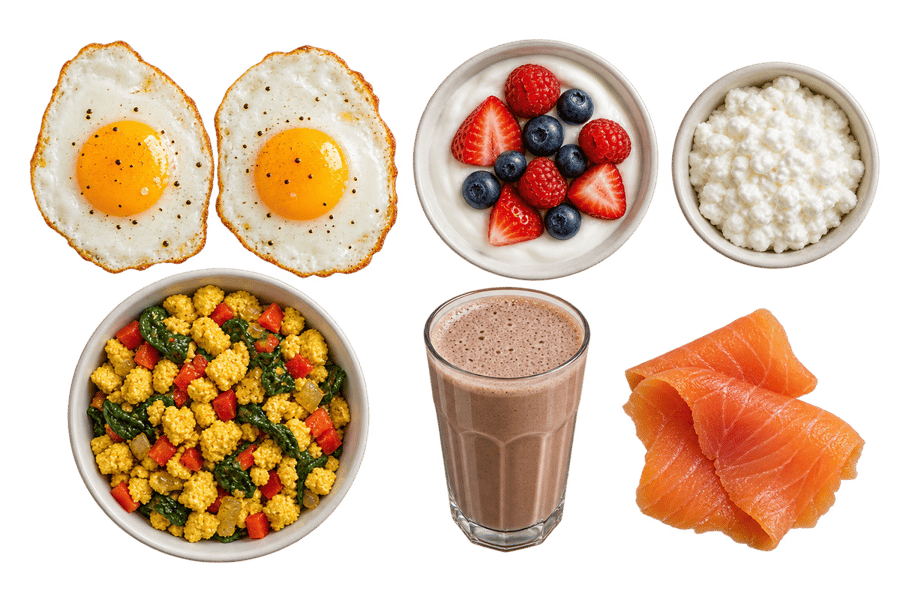
One swap for each common breakfast
The grades are for a 170 pound person eating 2,000 calories over three meals.
| Usual breakfast | Protein | Grade | Swap | Protein after | Grade after |
|---|---|---|---|---|---|
| A doughnut | 4 g | F | Greek yogurt and blueberries | 18 g | C |
| A bagel with butter | 9 g | D | Two eggs on whole wheat toast | 18 g | C |
| Cereal and milk | 11 g | D | Oatmeal, a banana and a container of Greek yogurt | 24 g | B |
| Oatmeal and a banana | 7 g | C | Add a container of plain Greek yogurt | 24 g | B |
| Two eggs and buttered toast | 18 g | C | A third egg and a cup of strawberries | 25 g | B |
| Greek yogurt and blueberries | 18 g | C | Half a container more and a handful of almonds | 33 g | B+ |
Every swap lifts the grade, but the Muscle meter only clears at about 30 g for a 170 pound person, and a plate has to clear all six jobs a meal does to be an A. Add a container of Greek yogurt to the three eggs, toast and strawberries and it’s an A.
Greek yogurt does a lot of the work here. One 170 g container of plain nonfat Greek yogurt has 17 g of protein and 100 calories.
The protein breakfast foods
| Food | Amount | Protein | Calories |
|---|---|---|---|
| Plain nonfat Greek yogurt | 1 container (170 g) | 17 g | 100 |
| Cottage cheese | 1 cup | 26 g | 215 |
| Eggs | 3 large | 18 g | 235 |
| Canned tuna | a palm (3 oz) | 22 g | 100 |
| Milk | 1 cup | 8 g | 120 |
| Peanut butter | 2 tablespoons | 8 g | 190 |
A protein shake works too, if you like them. The grams vary a lot by brand, so read the label.
What about “protein” cereals and bars?
The 2025 to 2030 US guidelines tell Americans to “significantly reduce” highly processed, refined carbohydrates, including “ready-to-eat or packaged breakfast options,” and protein cereals and bars are packaged breakfast options too. Eggs and yogurt get you there with food you could name.
What to do
- Pick one breakfast you eat most and make the one swap in the table.
- Keep it for two weeks before changing anything else.
- Check it in the meal checker, which tries every swap on your plate.
4 sources
- Mamerow et al., Dietary protein distribution positively influences 24-h muscle protein synthesis in healthy adults, Journal of Nutrition, 2014pmc.ncbi.nlm.nih.gov
- US Department of Agriculture and US Department of Health and Human Services, Dietary Guidelines for Americans, 2025 to 2030, January 2026cdn.realfood.gov
- Gebhardt and Thomas, Nutritive Value of Foods, Home and Garden Bulletin 72, USDA Agricultural Research Service, 2002ars.usda.gov
- USDA National Nutrient Database, Yogurt, Greek, plain, nonfat, via nutritionvalue.orgnutritionvalue.org