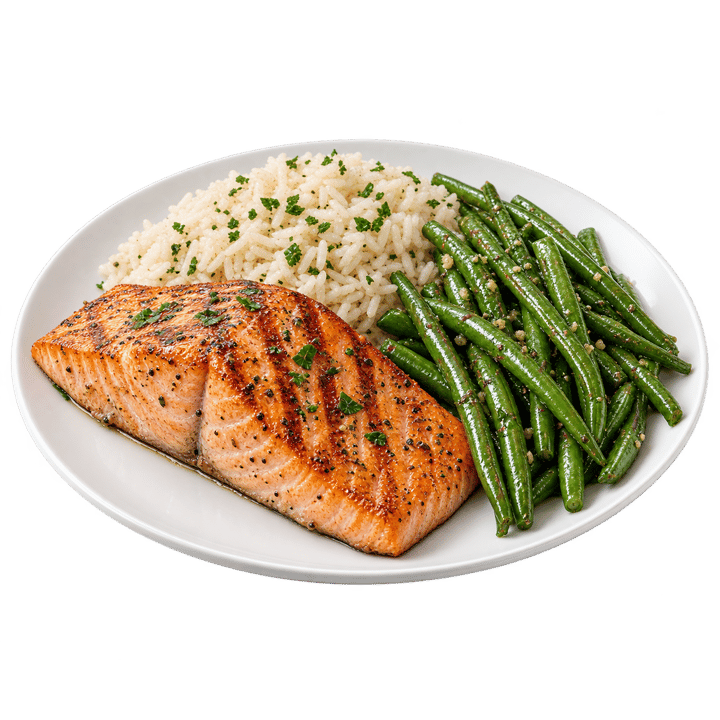
How long before bed should you stop eating?
About three hours is a good line. In a 7.5 week trial, people who finished their last meal at least 3 hours before sleep had a lower heart rate and higher HRV at night. And in a study of reflux, people who went to bed less than 3 hours after dinner had much higher odds of it than people who waited 4 hours or more.
You’ve probably heard “no food after 8 pm.” The clock time isn’t the point, since someone who sleeps at 1 am and someone who sleeps at 9 pm need different cutoffs. What the studies measure is the gap between the last bite and lying down.
People also mix up two questions. One is whether late eating makes you gain weight, and a calorie at 10 pm still counts the same as one at noon (bodyfat.guide covers that). The other is what a full stomach does to your night, and that’s where the three hours come from.
We’d close the kitchen about three hours before bed, and make dinner a normal plate rather than the day’s biggest one if you tend to eat late.
Lying down on a full stomach is a bit like laying a full glass on its side. It works much better once the glass is mostly empty.
What do the studies show?
| Study | What they did | What happened |
|---|---|---|
| 39 adults with overweight or obesity, aged 36 to 75, 2026 | For 7.5 weeks, one group moved their last meal to at least 3 hours before sleep | Lower heart rate and higher HRV at night, a better nighttime drop in blood pressure, and lower blood sugar in a morning glucose test |
| 147 people with reflux and 294 people without, 2005 | Asked how long they waited between dinner and bed | Under 3 hours went with about 7 times the odds of reflux compared with 4 hours or more |
| 16 adults with overweight or obesity, 2022 | Ate the same meals on an early schedule and a late one, with the last meal 2.5 hours before bed | On the late schedule, the odds of feeling hungry doubled and they burned about 60 fewer calories over the waking day |
The reflux study asked people to remember their habits, so it shows a link rather than proof. The 2022 study kept weight steady on purpose and didn’t test whether late eating leads to weight gain over months. The 2026 trial is the one that changed the timing and measured what happened, and it found better heart numbers at night.
hrv.guide has more on what late dinners do to HRV.
What if I get hungry late?
Eat something small, and give it a little time before you lie down. If you take diabetes medicine that can cause lows at night, your care team may want you to have a bedtime snack, so follow their plan.
What to do
- Work back from your bedtime. If you go to bed at 11, finish eating by about 8.
- Make dinner a normal plate, inside your window from the plate size calculator.
- If you have heartburn at night, the gap is the first thing to try, and see a doctor if it keeps happening.
3 sources
- Grimaldi et al., Sleep-aligned extended overnight fasting improves nighttime and daytime cardiometabolic function, Arteriosclerosis, Thrombosis, and Vascular Biology, 2026europepmc.org
- Fujiwara et al., Association between dinner-to-bed time and gastro-esophageal reflux disease, American Journal of Gastroenterology, 2005europepmc.org
- Vujović et al., Late isocaloric eating increases hunger, decreases energy expenditure, and modifies metabolic pathways in adults with overweight and obesity, Cell Metabolism, 2022pmc.ncbi.nlm.nih.gov