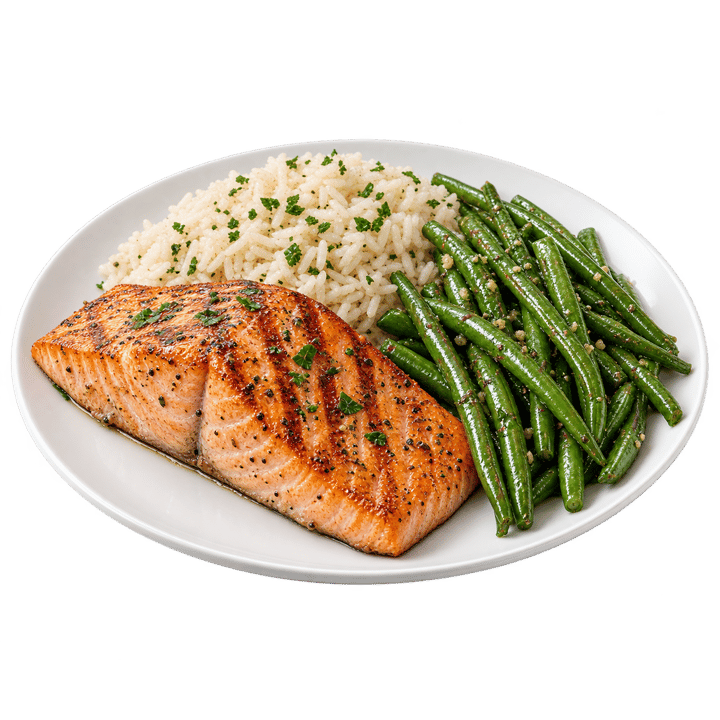
Your body can only use 30 g of protein at a meal
Short answerNo
On this page
No. The 30 g idea came from small studies that measured muscle building for a few hours after a workout. In a 2023 trial, 100 g of protein gave a bigger response than 25 g, and it lasted more than 12 hours. Reach your share at each meal and don’t worry about going over.
What we’d do
Treat 30 to 40 g a plate (for a 170 lb person eating three times a day) as the amount to reach, and let a bigger protein meal be a bigger protein meal. A 60 g steak dinner isn’t wasted. Still put protein on every plate, starting with breakfast, since spreading it out helped muscle building in a separate trial. The Gyroscope app personalizes yours.
If you remember three things
- The limit came from 6 men. A 2009 study found muscle building after a leg workout topped out at 20 g of egg protein.
- 100 g beat 25 g. In 36 young men after a full-body workout, the bigger dose built more and kept going for over 12 hours.
- It’s a floor to reach. Aim for your share at every meal. Going over is fine.
Where the 30 g idea came from
In 2009, researchers in Canada had 6 healthy young men do a hard leg workout on five separate days. Each time, the men drank 0, 5, 10, 20 or 40 g of egg protein afterward, and the team measured how fast their leg muscles built new protein. It rose with the dose up to 20 g and then stopped rising. At 20 and 40 g, the men also burned more of one amino acid for fuel. The authors concluded that “Ingestion of 20 g intact protein is sufficient to maximally stimulate” muscle building after exercise.
It was a careful finding about muscle building in the hours after one leg workout. In gyms it turned into “your body can only absorb 20 to 30 g at a time”, which is a different claim. The study didn’t measure how much protein the body absorbs, and it only watched for a few hours.
A simple way to picture it
The old idea treats protein like a parking lot with 30 spaces, where car 31 has to drive away. The 2023 trial looks more like a lot with an overflow area. When more cars arrive, more of them wait and get parked over the next 12 hours.
What the newer trials found
0, 25 or 100 g after a full-body workout
36 healthy young men, 12 per group, measured for 12 hours. Trommelen and colleagues, 2023
100 g gave a bigger muscle building response than 25 g, about 20% higher in the first 4 hours and about 40% higher from hours 4 to 12. Protein had a negligible effect on how much amino acid the body burned for fuel.
Young men only, one meal, after a workout that used the whole body.
What the studies add up to
A 2018 review. Schoenfeld and Aragon
For building muscle, about 0.4 g per kg of body weight a meal over at least four meals, and up to 0.55 g per kg. Higher doses burn more amino acids, but not all the extra is lost.
Written for people trying to build muscle.
Even or skewed through the day
8 adults, a week each way. Mamerow and colleagues, 2014
About 30 g at each meal built 25% more muscle protein over 24 hours than about 11 g, 16 g and 63 g.
Small, and it measured muscle building, not muscle gained.
The 2023 authors wrote that the belief in a short, capped response “lacks scientific proof”.
What it means for your plate
The two findings fit together. More protein at one meal isn’t wasted, and getting a decent amount at every meal still helps. For a 170 lb (77 kg) person, the review’s 0.4 g per kg is about 31 g a meal, which is close to the 30 g line on the meal checker’s Muscle meter. The 2025 to 2030 US guidelines say to “Prioritize Protein Foods at Every Meal”, at 1.2 to 1.6 g per kg a day.
Most people’s gap is at breakfast. A big chicken dinner is fine. A breakfast of cereal and milk, at 11 g, is the plate to fix. Muscle: protein on every plate shows what 30 g looks like, and protein.guide covers the day.
If you have kidney disease, ask your doctor how much protein is right for you before you eat more.
5 sources
- Moore et al., Ingested protein dose response of muscle and albumin protein synthesis after resistance exercise in young men, American Journal of Clinical Nutrition, 2009europepmc.org
- Trommelen et al., The anabolic response to protein ingestion during recovery from exercise has no upper limit in magnitude and duration in vivo in humans, Cell Reports Medicine, 2023pmc.ncbi.nlm.nih.gov
- Schoenfeld and Aragon, How much protein can the body use in a single meal for muscle-building? Implications for daily protein distribution, Journal of the International Society of Sports Nutrition, 2018pmc.ncbi.nlm.nih.gov
- Mamerow et al., Dietary protein distribution positively influences 24-h muscle protein synthesis in healthy adults, Journal of Nutrition, 2014europepmc.org
- US Department of Agriculture and US Department of Health and Human Services, Dietary Guidelines for Americans, 2025 to 2030, January 2026cdn.realfood.gov